Showing posts with label Safety. Show all posts

Wednesday, August 20, 2008

Hazmat Suit to the rescue...

Yes I used this suit in the construction of the Cottage...

... and in fact for a very crucial part of the construction. Can you guess why I needed it as well as the breather beside it?

In an up coming post I will describe why....

Friday, August 15, 2008

The Importance of Scaffolding!

I can't over emphasize the importance of scaffolding!

In fact once we had gotten the scaffolding for the siding installation, we realized that we should have gotten it much sooner to assist in many of the previous tasks. It would have made the following much easier and safer:

  • Roof truss loading and installation
  • Building of the deck substructure
  • Installation of the beams for the gazebo and the front porch.
Here we see my youngest son, Adric, installing a piece of siding under the gable on the east wall. It may not look so daunting in this picture but when you are standing at the far right of the scaffold, because of the steep slope of the location, it is two and a half stories down - quite frightening for those with a phobia, and quite dangerous if you fall.

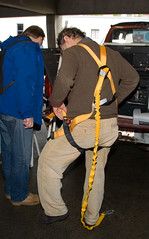
Adric is also wearing a safety harness with the harness tied of to a secure spot on the Cottage.

Doing anything on a slope is very difficult with a ladder, an extension ladder or even the fancy ladder that handles slopes that I mentioned in an earlier post. You are constantly moving and stabilizing the ladder - plus you need two. With scaffolding you put it up once, and only need to move the platform up as you move up the wall. In this picture you can see that we used two platforms. I still love my "World's Greatest Ladder" but the scaffolding is better suited when two people need to install long / big pieces of material at a height.

RECOMMENDATION: If I did it again I would get the scaffolding much earlier, I would get 4-foot scaffolding, and I would get more scaffolding. The scaffolding you see here is 2-feet wide by 5-feet tall, and is only 10-feet long. When the highest platform, shown here between the third set of scaffolding, the 2-foot platform just seemed a bit narrow. I would get three more side pieces and the associated braces so that the platform could be longer and hence would not need to be moved as much.

Saturday, August 9, 2008

Building Smart - order is Important!

With good planning it was easy to reach spots like the main floor walls or even the roof without having to use ladders or even scaffolding.

Here the completed deck substructure covered with some spare pieces of plywood served as a ready-made scaffold. This allowed us to move around quicker and to use stepladders rather than extension ladders or scaffolding.

Where getting even higher was necessary, just adding one layer of scaffold was all that was needed.

Thursday, August 7, 2008

Hurricane Clips! What Hurricane?

The roof trusses were secured at each of the outside, and load bearing walls, with something calls a hurricane clip.

The purpose of the hurricane clip is as the name suggests to hold the roof down in a big wind. The trusses could actually be toe-nailed in place, and hence not move around. However, this is not sufficient when the wind blows...

The uplift under the eaves during strong wind could be strong enough to rip off the roof.

Monday, August 4, 2008

Pinning that Post

We used two ways to secure the deck posts on top of the concrete piers. The first ways is illustrated in this picture.

Basically a hole is drilled in the bottom of the post, into which the anchor bolt sticking out of the goes into. The trick is making sure the hole is deep enough, or shall I say high enough for the pin (that's the bolt) to completely fit into.

When raised and siting on the "pin" the post just isn't going to move.

So what is the black stuff on top of the concrete pier?

There is building code requirement, and just smart practice, to isolate the dampness of concrete from any wood. We did a similar isolation between the concrete footing and/or wall from the wood walls by using something called a sill gasket. Here, it is generally accepted that a piece of tar paper is used to isolate. We used an asphalt shingle - cut to fit.

Sunday, August 3, 2008

Building a Roof by the Labels

The trusses came with a set of plans and drawings. The drawing helped to decide what order the trusses needed to be assembled.

The drawings also indicated where to place additional bracing. Bracing between and among the trusses is very importsant to provide that additional lateral stability and strength to the roof.

In addition, the truss builder, Kent Trusses, placed stickers on the chords where the lateral bracing needs to go. "Chord" is truss lingo for the wood beams between the foot (bottom) and other parts of the truss.

There were stickers to indicate which trusses to laminate. "Laminate" is more truss lingo to indicate that two identical trusses need to be nailed together to build a thicker, stronger load bearing truss.

Not shown, was a third sticker to indicate the exact location on a truss where the load bearing wall needs to be.

And to make it even easier the stickers were colour coded:

  • Green for "Brace"
  • Blue for "Laminate"
  • Yellow for "Load Bearing"

Friday, August 1, 2008

Stairway to Heaven!

Up to this weekend getting up into the Cottage was either a running leap onto the front porch or using the small step ladder as a makeshift stairs up to the porch. Both or which were difficult when you are carrying tools or materials.

... Plus using a step ladder like this isn't exactly the safest way to use a step ladder - they even print warnings all over the step ladder to this effect.

And the stairs kept disappearing when someone needed to use the step ladder...

So I broken down this weekend and built a set of temporary stairs. It was quite easy really! I cheated a bit by first buying a set of pre-cut stringers - three in fact. Stringers are the supports for the boards that are used for the steps themselves.

My my quick and dirty steps have six steps, and except for the pre-cut stringers were made from strap lumber I had. I made the steps 36 inches wide using a combination of a 2x4 and a 2x6 for each step. Scrap wood was used to level and support the bottom of the stringers, and I secured the tops of the stringers to the beam of the porch using a few 3.5 inch screws for each.

With another piece of scrap lumber secured to the posts at about 36 inches, I have a completed stairway. And it only took about an hour to do it.

Just in the nick of time as well... and I have to confess I had a second reason for the stairs. My Mom and Dad came up for a visit on Saturday. My Dad has been very curious on how the work was progressing, and I guess he just couldn't wait any longer...

That is the second reason. My Dad is 8 months short of being 80 years old, and while still quite active, I thought having the stairs would make his tour of the cottage so much more enjoyable.

Monday, July 28, 2008

10 Tips for a Safe Cottage Construction Site

I am a bit of a stickler for safety on the our Cottage construction site, and it is paying off as we haven't had any major injuries other than a few cuts and bruises.

My rules are simple:

  1. Eye protection shall be used with ALL power tools, and when hammering. This includes not only the operator of the tool but anyone helping them.
  2. Any power tool shall be removed from its source of power, BEFORE being adjusted or fixed. This includes both air and electrical tools.
  3. All falling hazards should be immediately covered safely or cordoned off.
  4. If you remove a brace or other board, the nails in it should be immediately removed.
  5. When a team of people are working on a particular task, the step shall be clearly understood before starting the task. There shall be a means of escape from danger for all members of the team
  6. All ladders shall be secured by a co-worker in situation where the ladder is no unstable soil, or the work is need a falling hazard.
  7. Working on a roof requires use of a safety harness.
  8. No one shall work alone when the work involves danger of falling, or the lifting of heavy materials.
  9. All work material, tools and debris or other items that pose a tripping hazard shall be removed from immediate work locations or placed in a safe nearby location with respect to the work activity.
  10. Take all precautions to protect yourself from environmental conditions: use sunscreen, drink plenty of fluids, wear rain gear, stop work(don't use power tools) and seek shelter in thunder storms,

Sunday, July 27, 2008

6 Tips for Safely Keeping Hydrated on the Work Site

The weather this summer has been hot and very humid! It is sometimes difficult to remember to keep yourself hydrated. the heat and simply working hard means you are sweating out and using up precious fluids. Without replenishing them you can very quickly get in to medical problems - at the very least exhaustion and sore muscles (perhaps cramps) to the worst case such as severe dehydration and shock.

Right from the start I set up a hydration center with both water and a cooler with sport drinks. Here are a few tricks and tips I have learned from the experts or experience:

  • When you sweat you loose more than just water - you loose precious electrolytes and other goodies that your body needs. So just drinking water can set these electrolytes dangerously out of balance causing cramps for instance.
  • I like to alternate between a sport drink and just water to alleviate these problems - and it works!
  • I set up the hydration centre in the shade. Once the basement was covered with the floor I placed it there. Not only was it in the shade but the basement was just cooler.
  • Provide places to sit. Everyone is on their feet slaving away. When taking a break, having a comfortable seat to rest your fanny is sure nice - especially for this old man...
  • Top keep the drinks cool, I use a portable cooler with a cooling system. It isn't a fridge but certainly provided adequate welcome chilling of the drinks. Remember I have a generator going a good 50% of the time, so power is readily available.
  • Stay away from alcoholic beverages. Contrary to popular myth they actually make the de-hydration worse, let alone the safety issues of alcohol on a job site. Beer is best left to the end of the day celebration and even then in moderation.

Saturday, July 26, 2008

I'll never use another extention ladder again!

I have come to appreciate a new ladder, "World's Greatest Multi-Use Ladder", which I purchased at Costco. You can find a great review of the ladder at www.inspectorsjournal.com. It isn't a 'Little Giant' but it is very close! and at less than half the price ($139.99) it fits the bill!

I have found that the "World's Greatest Multi-Use Ladder" is vastly superior to the standard extension ladder in the following ways:

  • It is less awkward to move and setup
  • It is much more stable on just about any kind of ground conditions. This is particularly comforting to me as I am not a big fan of heights so having a more stable platform just makes the job go quicker
  • It is great on sloped work site - like the side of the hill that the "Cottage on the Edge" rests. The step ladder mode an have different lengths of 'ladder for each side of the step ladder. In such a configuration the ladder is very stable and much easier to level and secure.
  • I can work on a larger area without having to move the ladder. For instance, when putting up the 50-inch joists for the deck, the double-sided nature of the ladder in step ladder mode means I can get to both ends of the joist without having to move the ladder. Not having to constantly move the ladder saves time - big time!
  • Furthermore, two people can work on the ladder in step ladder mode, which is really a time saver, for instance, when installing the joists I mentioned above. Each person can be working in one end of the joist.
This ladder converts without tools to: 4 positions as a step ladder, 8 heights as an extension ladder, 6 positions as a stairway ladder, 3 heights as a scaffold, and 3 heights as a wall ladder. Great for use on stairs.


Monday, July 14, 2008

Rain, Rain, and More Rain...

Rain means construction halts!

Rain means you can't use power tools - unless you have a death by electrocution wish.

After 2 days of rain, and not getting much accomplished, we erected a makeshift roof with a huge tarp and a few poles to suspend it above the walls.

It worked well enough that I could continue to work inside - under the big top - to do the framing of all the interior walls.

Saturday, July 5, 2008

Embedded for Life!

I was amazed how much safer the jack posts became once the concrete basement floor was poured. While we had nailed the bottom plates of the jack posts to the concrete footings they still didn't give that great Rock of Gibraltar feeling.

With at least 4 inches of concrete poured around them, they sure feel solid NOW!

Friday, July 4, 2008

Sawing Central

Over the past three weekend I have developed quite a system to measuring and cutting the lumber. I use three combination tables and saw horses as illustrated in the picture.

I use two to hold and measure the lumber, then swing the piece across to the third table where I have a chop saw. From there I take the piece about 4 paces and place it up on the floor ready for assembly.

Monday, June 30, 2008

4 Steps to Rasing a Wall: Square, Prepare, Lift, Level and Brace,

Raising a wall is certainly not for the weak of body or mind. It requires strength and a mind for ensuring the wall is:

  • Square
  • Plumb, and
  • Braced
Step 1: Making it Square
Well you don't actually make it 'a' square. Very seldom is a wall a perfect square!

What you need to do is make sure that the top and side studs are at a perfect 90 degrees. This is by applying a mathematics trick you learned way back in high school: a rectangle is perfectly 'square' when the distance from one corner to the another equals the distance on the opposing pair of corners. It takes a bit of effort making the wall square - usually done using a "persuader" ( a sledge hammer in our case) to drive a corner while holding the opposite corner in place. While blocks nailed temporarily into the floor can be used to secure the opposite corner - having a helper makes this process faster.

Once 'square' you will want to freeze the square by nailing in a temporary board to the wall. Here you can see we used a piece of plywood.

Step 2: Prepare
We used temporary blockers on the floor to backstop the wall as we slid it in to place and lifted it into place. Can you see them still in place?

Before we lifted the wall we first nailed a 12 foot 2 x 6 to support the wall. In this case on the left side of the wall, can you see it in place in the above picture? I secured it with one nail and had it lying so it was sticking past the top plate. This is so as we lifted the wall the brace would follow us dragging on the floor.

There are a few other things you need to get and have nearby:
  • Air nailer with plenty of nails
  • loose 3.5" nails and a hammer
  • A level
  • More bracing boards if you think you may need them
Step 3: Lift
Lifting a wall, especially when the wall is large can't be done alone. Get help! This requires at lease two people. It is a good idea to first raise and prop the top plate with a scrap piece of lumber. This make it easy to get your hands under the wall in the "clean and jerk" action you are about to do... Yes! framing Olympics...

Step 4 & 5: Level and Brace
The action of leveling and bracing really happens at the same time. First you do some bracing, then some leveling, and then repeat the process.

Once the wall is in the right location, secure the sole plate to the floor. Make sure you are getting lots of lumber when you nail. Put your nails through the sole plate and into the joists in the floor. ASIDE: It helps to have marked their location before your lifted the wall.

I like to level the end of the wall with the prepared brace first. This requires at least two people - although a third is sure handy. One holds the wall, and uses the level to ensure that end of the wall is perfectly vertical. The second person takes the brace and nails the other end to the side of the floor. Both ends of the wall should be secured in this way.

For this wall we simply put the small wall (right side of the wall in the picture) in place, leveled both walls simultaneously and nailed them together.

In the above picture you can also see we had the next wall, to the left of this current wall ready to lift, level and brace.

Monday, June 16, 2008

3 Key Conveniences for a Happy Construction Team


Except two weeks of vacation, the construction schedule has most of the construction happening on weekends. We all have day jobs -- so my construction team, consisting mostly of my three sons and my wife, donate their weekends to the cause. I have been taking every Friday off in the month of June to prepare the construction site, and to get whatever I can get started.

Long and hot days make for tired and sore bodies. Out in the great outdoors it is difficult to have the conveniences of home - but we try.

1. Comfortable Sleeping arrangements
Nothing is more dangerous is tired workers. I set out to ensure we could provide the best under the circumstance. I am fortunate in that I had a headstart. I had previously built a small one room bunkie which can accommodate 2 -3 people, and a gazebo.

In the gazebo I have semi-permanently (for the summer construction season) pitched a 3 - 4 person tent. I furnished it with comfy mattresses, pillows and sleeping bags.

The bunkie has a futon for two and a small loft with a single mattress. Both come with pillows and blankets.

2. Private Toilet Facilities
There is an outhouse with a composting toilet. Composting toilets although taller than conventional toilets have the same features once you climb on to them.

3. Washing Capabilities
For full body washes (aka showers and baths) the facility is found just over the edge of the dock. Combined with a ecologically positive bar of soap and bottle of shampoo, the lake makes for effective if not a bit cool wash-down. As it has been very hot and humid I haven't been hearing any complaints!

In the interim and for times when a bit of touch-up is required - like when my wife insists we wash our hands before meals, we use wipes. They work very effective, and they are great for getting the insect repellent off just before climbing in the very welcome bed and sleeping bag each night.

4. Good Food & Drink
Food and drink is probably the easiest. We simply use a BBQ and carry our food up to the cottage for the weekend in a cooler. Our BBQ comes with a side burner so making coffee or tea or boiling water to wash dishes is very easy.

Keeping drinks and food is a bit of a problem beyond a few days as the ice pack are really being taxed in the hot weather. However, we retrieved a refrigerated cooler from storage and have plugged that in to the generator during the day. The 'boosted' cooler seems to keep things just a bit cooler. It only runs when we have the generator on to power our construction tools but for the past two weekends that has been pretty consistently from 9am to 7pm each day, with short spots for lunch and supper.

We keep the booster cooler with drinks and a big water jug right at the construction site, within easy reach for anyone to crack open a cool one.

...and regarding the 'Cool ones', beer is strictly for the after-supper celebration of a fine day's work, and to help ease the pain of those long under-exercised but now overused muscles. We use drinks with great electrolyte balance, like the most commonly recognized Gatorade.